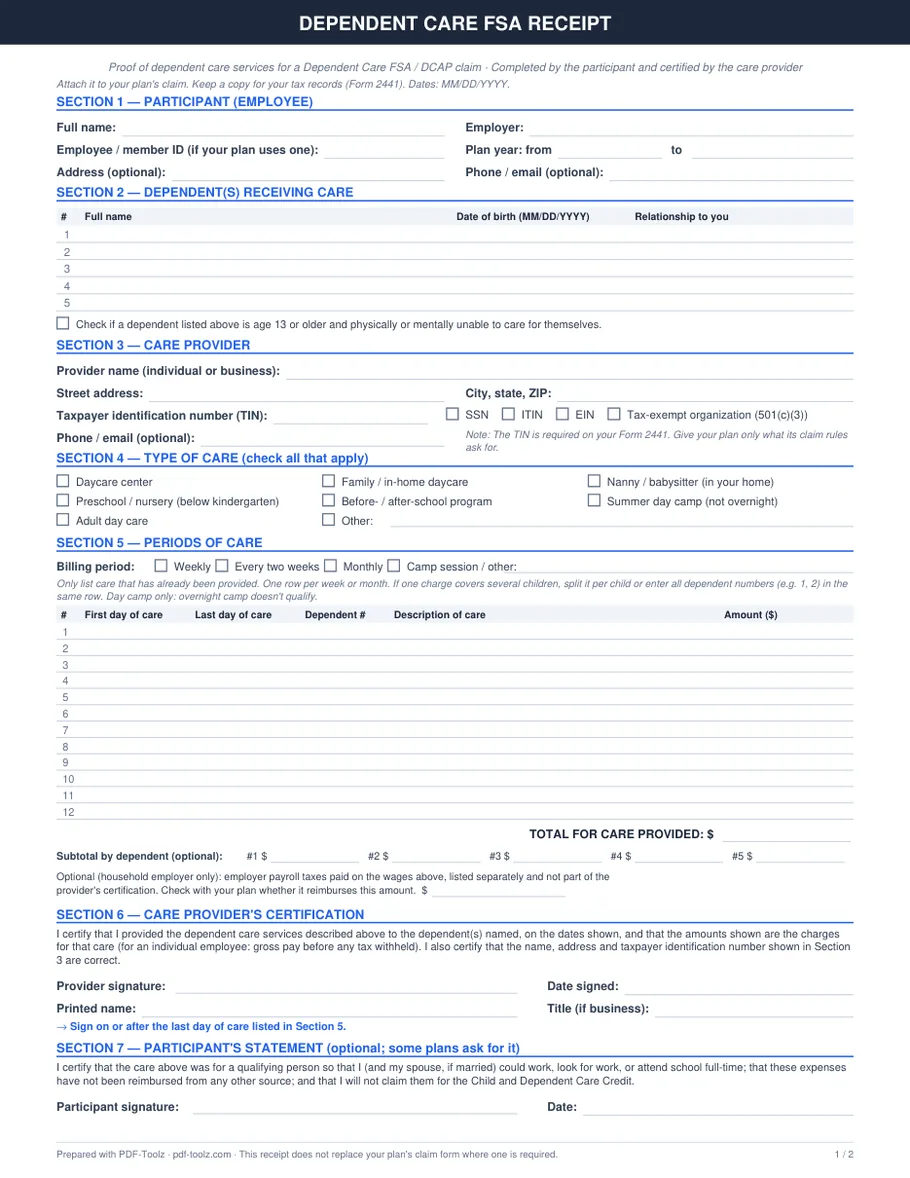
Dependent Care FSA Receipt Form: Fillable PDF for Daycare, Nannies and Summer Day Camps
Fill it in online and download it as a PDF
Your dependent care FSA won't pay you back on your word alone. It needs proof from your care provider: what the care was, when it happened and how much it cost. Daycare centers usually print a statement. Nannies, in-home daycares and many summer camps don't, so the claim stalls.
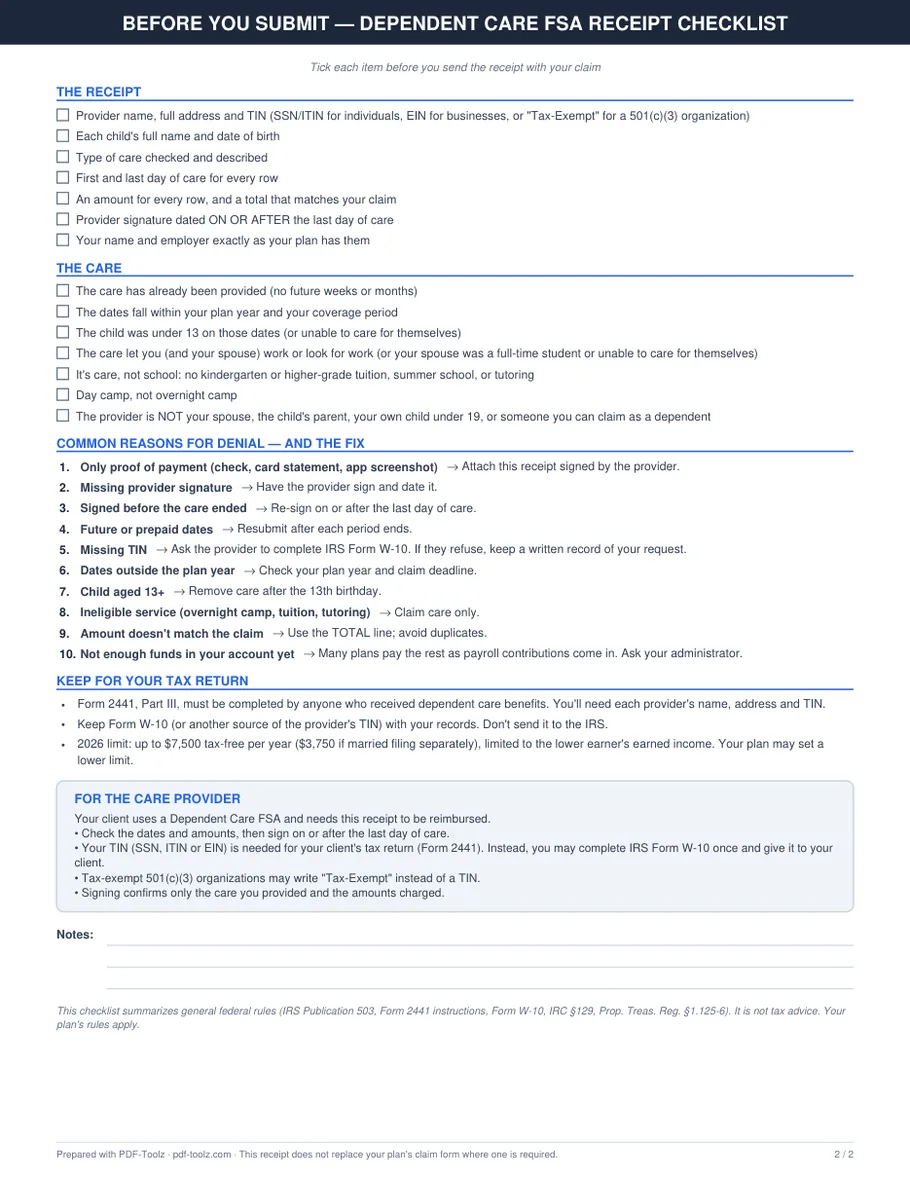
This dependent care FSA receipt form fixes that. It works for a daycare center, a family daycare, a nanny or babysitter, or a summer day camp, for one child or several, and for one week or a whole month. Fill it in on screen with PDF-Toolz, have your provider sign it, and send it with your claim. Page 2 is a checklist of the most common reasons claims get denied, so you can fix problems before you submit.
What this receipt includes
Any provider, one or more children
Daycare center, family daycare, nanny or babysitter, preschool, before/after-school program or summer day camp, with rows for up to five children.
Weekly or monthly periods
A periods table with 12 rows (weeks, months or camp sessions), a total line and the provider's certification and signature.
Checklist before you submit
Page 2 lists what to check and the most common reasons dependent care FSA claims get denied, with the fix for each.
Last reviewed: November 2026. This page explains the general federal rules. It isn't tax or legal advice, and your FSA plan's own claim rules always apply.
What is a dependent care FSA receipt, and when do you need one?
A Dependent Care FSA (also called a DCFSA or dependent care assistance program, DCAP) lets you pay for child care with pre-tax money from your paycheck. You pay the provider first, then ask your plan administrator to reimburse you.
To reimburse you, the plan must substantiate every claim. Under the IRS proposed cafeteria plan regulations (Prop. Treas. Reg. § 1.125-6(b)(3)), that proof must come from an independent third party, usually the care provider, and must show:
a description of the service (for example, "full-time child care");
the date(s) of the service; and
the amount.
The same rule says that self-certification doesn't count: a statement from you, the employee, isn't enough without proof from the provider. A note you write yourself, a canceled check or a Venmo screenshot proves you paid, but not what the care was or when it happened.
You need a separate receipt form when:
your nanny or babysitter doesn't give receipts;
your in-home or family daycare gives only handwritten notes or nothing at all;
your summer day camp sends an order confirmation with no dates or tax ID;
your plan asks for the provider's signature on its claim; or
you paid with your FSA debit card and the administrator asks for documentation after the fact.
Receipt vs. claim form. Most administrators have their own claim form (your request to be paid). This page gives you the receipt (the provider's proof). Many plans accept a receipt like this one attached to their claim form or online claim; some insist that the provider sign the administrator's own form. If your plan has its own form for the provider to sign, use it, and attach this receipt if it helps. If that form isn't fillable, you can type into it with Edit PDF.
What a valid dependent care FSA receipt must include
Some details are required by federal rules; others are what plans commonly ask for. Our form includes both.
Field
Why it's there
Provider name
Shows who gave the care (independent third party). Also goes on Form 2441.
Provider address
Required on Form 2441, Part I.
Provider TIN: SSN or ITIN for an individual, EIN for a business
Required on Form 2441 to keep your FSA money tax-free. Tax-exempt organizations (such as a church or school) can write "Tax-Exempt" instead.
Your name (employee/participant), employer, and plan year
Lets the plan match the receipt to your account. A plan requirement, not a tax rule.
Child's (dependent's) name and date of birth
The care must be for a qualifying person, usually your child under age 13 when the care was provided. Plans commonly ask for the name; the date of birth shows age.
Type of care (daycare, nanny, preschool, before/after-school, day camp)
The rule asks for a description of the service.
First and last day of care for each period
The rule asks for the dates. Care counts when it's provided, not when you pay.
Amount for each period and total
The rule asks for the amount.
Provider's certification and signature, with date
Many plans ask for the provider's signature. It shows the details come from the provider, not from you.
How to fill out the receipt, step by step
Your details. Enter your full name, employer, employee or member ID (if your plan uses one) and the plan year. Use your name exactly as it appears with your FSA administrator.
Dependent(s). Add each child (or other qualifying person) with date of birth. A child must be under 13 on the dates of care. If your child turns 13 during the year, only care before the birthday counts. A spouse or dependent of any age who can't care for themselves and lives with you more than half the year can also qualify (IRS Publication 503).
Provider details. Business or individual name, full address and taxpayer identification number: SSN or ITIN for an individual (nanny, babysitter, home daycare run as a sole proprietor), EIN for a daycare center, camp or other organization, or "Tax-Exempt" for a 501(c)(3) organization. Ask the provider to fill in IRS Form W-10 if you don't have this information. You keep the W-10; you don't send it to the IRS.
Type of care. Tick the box: daycare center, family/in-home daycare, nanny/babysitter, preschool, before/after-school program, summer day camp, adult day care or other.
Periods of care. For each week or month: first day, last day, child(ren) and amount. Only list care that has already happened. Under the proposed regulations (Prop. Treas. Reg. § 1.125-6(a)(4)(i)), expenses count when the care is provided, not when you're billed or pay, so plans can't reimburse care before it's provided.
Total. Add up the periods. Check it against what you're claiming.
Provider certification and signature. The provider signs and dates the statement on or after the last day of care listed. A signature dated before the care ends is one of the easiest ways to get a claim kicked back.
Submit and keep a copy. Attach the receipt to your plan's claim (online, app, email, fax or mail, whatever your administrator uses) and keep a copy with your tax records. You'll need the provider details again for Form 2441.
With PDF-Toolz you can type into every field and leave the rows you don't need empty, then sign the PDF digitally with Sign PDF or print it for a handwritten signature. Check whether your plan accepts electronic signatures.
Versions: nanny, daycare center, summer day camp, several children, weekly or monthly
Nanny or babysitter
Enter the gross pay for the period (before any tax withheld). Your nanny signs for what they earned for that care.
If your nanny is your household employee, the employer taxes you pay on their wages are also work-related care expenses under Publication 503. Some plans reimburse them, some don't. List them on the separate line of the receipt and check with your plan.
A nanny who works in your home is generally your household employee (Publication 503). In 2026, if you pay one household worker $3,000 or more in cash wages, Social Security and Medicare taxes apply (Publication 926). Your nanny's SSN or ITIN goes on your Form 2441.
A babysitter is treated the same way as a nanny, as long as the care lets you (and your spouse) work or look for work. A date-night sitter doesn't count.
Daycare center or preschool
Centers usually give an itemized statement. If it already shows your child's name, the center's name, the service, the dates and the amount, many plans accept it as is. Use this receipt when the statement is missing any of these, or your plan asks for a signature.
Preschool and nursery school below kindergarten count as care. Kindergarten and higher-grade tuition don't. Before- and after-school care for a child in kindergarten or above can count (Publication 503).
Centers use an EIN. Church-run or other 501(c)(3) programs may write "Tax-Exempt".
Summer day camp
A day camp can count, even a specialty camp (sports, computers). An overnight camp doesn't (Publication 503).
Summer school and tutoring are not care.
List each camp week as a period with its dates. Camps often take payment months ahead. Your plan will usually reimburse only after each week of camp has taken place.
Registration fees and deposits can be care expenses if they're needed to get the care, but a forfeited deposit for care that never happened isn't (Publication 503). Under the proposed regulations, a plan can't reimburse a non-refundable fee until care starts.
Several children
List each child with date of birth (up to five), and show in each period row which child the amount covers. There is also an optional subtotal per child.
The FSA limit is per household tax return, not per child (see 2026 limits below).
Weekly or monthly
The receipt has a periods table (up to 12 rows) and a billing-period box (weekly, every two weeks, monthly or camp session), so one form can cover four weeks of a month, or a whole summer of camp weeks.
Monthly receipts mean less paperwork. Weekly receipts get you reimbursed sooner, because each week counts as "incurred" once it ends.
Why dependent care FSA claims get denied (and how to fix it)
These are the reasons administrators and parents mention most often. The fixes come from the rules above.
No provider signature or no third-party proof. A self-made list or a payment record isn't enough. → Have the provider sign the receipt.
Payment proof instead of a service receipt. Canceled checks, bank or credit card statements and app screenshots don't show dates of care or the service. Some administrators say outright they don't accept them. → Use a receipt with service, dates and amount.
Future dates (prepaid care). You paid for next month or next summer. → Claim each period only after it ends.
Signature dated before the last day of care. → Sign on or after the last day.
Missing provider TIN. → Ask for Form W-10. If the provider refuses, see the FAQ below.
Dates outside the plan year or before you enrolled. → Check your plan year and coverage dates; claim each year's care under that year's plan.
Child 13 or older on the dates of care (unless incapable of self-care). → Remove care after the 13th birthday.
Ineligible service: overnight camp, kindergarten or school tuition, summer school, tutoring, lessons not tied to care, child support. → Claim only the care part.
Ineligible provider: your spouse, the child's other parent (for a child under 13), your own child under 19, or anyone you can claim as a dependent. → These payments can't be reimbursed.
Care wasn't so you could work. The care must let you (and your spouse) work or look for work. A spouse who is a full-time student or unable to care for themselves can also qualify (Publication 503).
Amount doesn't match the claim, or periods overlap with a previous claim. → Use the totals row and keep copies.
Not enough money in the account yet. Many plans reimburse dependent care only up to what has been deducted from your pay so far, and pay the rest as contributions come in.
If a claim is denied, ask your administrator which rule it failed and resubmit with the missing information. Parents on Reddit report that identical claims were approved one month and denied the next until they added the provider's signature and tax ID.
Example 1: Nanny, monthly
Maria pays her nanny $3,200 in gross wages for March 2026 to care for her son Leo (age 4) while she and her spouse work. On March 31, the nanny signs the receipt: type of care "nanny (in-home)", period 03/01/2026–03/31/2026, amount $3,200, SSN entered. Maria submits it on April 1. Maria's employer-share payroll taxes for March go on a separate line, because her plan reimburses them.
Watch the annual limit. At $3,200 a month, Maria reaches the $7,500 FSA limit in about 2.3 months (around March 10 if her plan year starts in January). Care for the rest of the year can't be reimbursed from her FSA, even with a valid receipt. Those expenses may still count for the Child and Dependent Care Credit, but the FSA money she excludes reduces the expenses she can use for the credit (up to $3,000 for one child or $6,000 for two or more), so after a full $7,500 exclusion there's usually little or nothing left to claim (Publication 503, Form 2441). Check the numbers on Form 2441 or with a tax professional.
Example 2: Two children at a daycare center, weekly
The Nguyens' daycare bills weekly for Ava (2) and Ben (5, in after-school care). Their plan asks for the provider's signature. The center director fills in one receipt with four weekly rows for each child and its EIN, then signs on the last day of the month.
Example 3: Summer day camp
James paid $1,800 in April for six weeks of day camp for his 9-year-old daughter. Under the "care is incurred when it's provided" rule, he submits the receipt after camp ends, or week by week as each week finishes. A one-week sleepaway camp in August doesn't count.
These examples are illustrative: names and amounts are made up and aren't official figures.
2026 limits: what changed
FSA exclusion limit: $7,500 per year ($3,750 if married filing separately), up from $5,000 ($2,500), for tax years beginning after December 31, 2025. The change comes from section 70404 of the One Big Beautiful Bill Act (P.L. 119-21), which the IRS now calls the Working Families Tax Cuts legislation. It amended IRC § 129(a)(2)(A), which now reads $7,500 ($3,750 for a married individual filing a separate return). The IRS confirms the new limit in Publication 15-B (2026) and on its Child and Dependent Care Credit page.
Older IRS guides still say $5,000. The current editions of Publication 503 and Form 2441 are for 2025 returns, so they still show the old $5,000 limit. The 2026 editions haven't been released yet. For care in 2026, the $7,500 limit applies.
The tax-free amount can't exceed your earned income or, if you're married, your spouse's earned income, whichever is smaller (IRC § 129(b)).
Your plan can set a lower limit. Check your election form or check with your plan.
Child and Dependent Care Credit (2026): up to 50% of up to $3,000 in expenses for one qualifying person, or $6,000 for two or more, depending on income (IRS). You can't use the same expenses for both the FSA and the credit, and FSA money you exclude reduces the expenses you can use for the credit.
Everyone who receives dependent care benefits must complete Part III of Form 2441 with their tax return, including the provider's name, address and TIN.
Fill out your receipt with PDF-Toolz
Open the receipt
Open the Dependent Care FSA Receipt and type in your details, your children and the provider's information.
Add your periods
Add one row per week or month, and check that the total matches your claim.
Sign and send
Download the PDF and have your provider sign it, by hand or with Sign PDF. Combine it with your plan's claim form using Merge PDF. If your administrator's upload has a size limit, use Compress PDF. Have a photo of a paper receipt? Turn it into a PDF with Image to PDF.
What should a daycare receipt for FSA reimbursement include?
The provider's name, address and tax ID (SSN, ITIN or EIN), your child's name, the type of care, the dates of care, the amount, and (if your plan asks) the provider's signature and date. Our receipt has a field for each.
Do I need my nanny's or daycare's Social Security number or EIN?
For your tax return, yes. Form 2441 asks for each provider's name, address and TIN, and you must file it to keep FSA money tax-free. Use Form W-10 to ask for it. If a provider refuses, report what you have, write "See Attached Statement" where the number goes, and attach a note explaining that you asked. The IRS says in its FAQ that this shows due diligence. Your plan may reimburse without the TIN, but some won't, so check with your plan.
Does the provider have to sign the receipt?
No federal rule requires a signature as such, but the proof must come from the provider, not from you, and many plans require the provider's signature to show that. Have the provider sign on or after the last day of care.
Can I get reimbursed for child care I paid in advance?
Not until the care has happened. Under the proposed regulations, dependent care expenses are incurred when the care is provided, not when you're billed or pay. Submit each week or month after it ends.
Does summer camp count for a dependent care FSA?
Day camp can count, including specialty day camps, if it lets you work. Overnight camp doesn't. Summer school and tutoring don't either.
Can I pay a grandparent or relative with my dependent care FSA?
Generally yes, if you (or your spouse) can't claim them as a dependent, they aren't your spouse, they aren't the child's parent (for a child under 13), and they aren't your own child under age 19. They'll need to give you their SSN for Form 2441.
My child turned 13 this year. What can I claim?
Only care provided before the 13th birthday (unless your child is physically or mentally unable to care for themselves). Split the period on the receipt at the birthday.
Is a Venmo, Zelle or bank transfer record enough?
Usually not on its own. It shows payment, not the service and dates of care. Attach a receipt signed by the provider.
What's the dependent care FSA limit for 2026?
$7,500 per household ($3,750 if married filing separately), up from $5,000, under IRC § 129 as amended by the One Big Beautiful Bill Act (P.L. 119-21). It's limited to the lower earner's earned income, and your plan may set a lower limit. The 2025 editions of Publication 503 and Form 2441 still show $5,000 because the 2026 editions aren't out yet.
Can I use one receipt for several children or several weeks?
Yes. The receipt lists up to five children with date of birth, and the periods table covers up to 12 weeks or months. Make sure each amount shows which child and dates it covers.
We use essential cookies for the website to function and, with your consent, cookies and mobile advertising identifiers for analytics, personalized ads, non-personalized ads, ads personalization, and conversion measurement with our partners.
These cookies are essential for the basic operation of the website and cannot be disabled. They enable key features such as secure access, user session management, and the administration of your cookie consent preferences.
Performance and Analytics
These cookies and mobile advertising identifiers help us understand how visitors interact with the website by collecting information anonymously. We use this data for analytics, ads personalization, personalized and non-personalized advertising, and to improve content and functionality based on user behavior. Some of this information may be shared with Google and other marketing partners for analytics, advertising, conversion measurement, and optimization purposes. For more details, please refer to our Privacy Policy, including information on how Google uses data from sites and apps that use its services.